Understand the geometry. Check the numbers.
Gear module and diametral pitch calculator
Find metric module from a pitch diameter and tooth count, or convert US diametral pitch to module. The results update as you type. Select the diameter unit before entering an inch measurement; module itself is always expressed in millimeters.
Your inputs
Results update immediately. Decimal point or comma accepted.
0.01 ≤ m ≤ 100
Whole number, 6 to 1,000.
Calculated result
- Metric module
- 2 mm
- Diametral pitch
- 12.7 teeth/in
- Pitch diameter
- 40 mm
- Standard outside diameter
- 44 mm
- Circular pitch
- 6.283185 mm
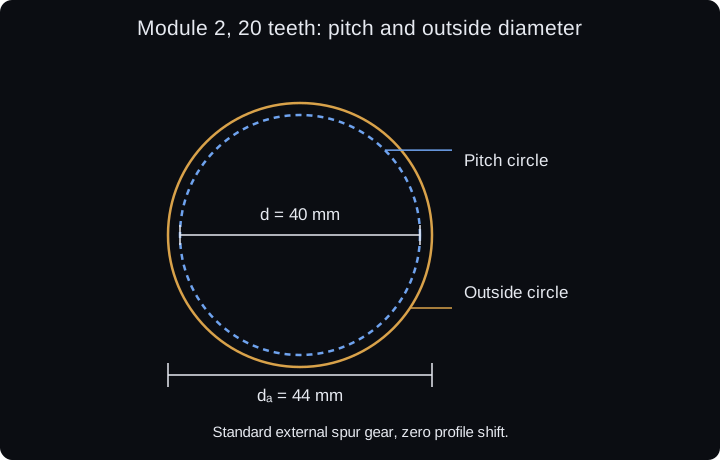
Standard external spur gear, zero profile shift. Numbers shown to six decimal places; transfer keeps the calculated precision.
What the results mean
Module m describes tooth size: m = d / z, where d is the reference pitch diameter in millimeters and z is the tooth count. For a known module, d = m × z. Diametral pitch uses teeth per inch of pitch diameter, so m = 25.4 / DP and DP = 25.4 / m.
The calculator also shows circular pitch p = π × m and outside diameter dₐ = m × (z + 2). That outside-diameter formula is restricted to a standard full-depth external spur gear with zero profile shift. It does not describe an internal gear, a bevel gear or a modified tooth tip.
Technical reference: KHK: Calculation of Gear Dimensions, table 4.1; KHK USA: module and diametral pitch.
| Module (mm) | DP | d (mm) | dₐ (mm) |
|---|---|---|---|
| 0.5 | 50.8 | 10 | 11 |
| 1 | 25.4 | 20 | 22 |
| 1.5 | 16.9333 | 30 | 33 |
| 2 | 12.7 | 40 | 44 |
| 3 | 8.4667 | 60 | 66 |
Worked example: 20 teeth at module 2
Enter a pitch diameter of 40 mm and 20 teeth. The module is 40 / 20 = 2 mm, the diametral pitch is 12.7 teeth/in, and the theoretical outside diameter is 2 × 22 = 44 mm. The circular pitch is approximately 6.283185 mm.
For a 12 DP gear, the module is 25.4 / 12 = 2.116666… mm. That is not the same size as a module 2 gear. The generator link retains the calculated number; the shorter displayed result is only for readability.
Measuring an unknown gear
A caliper across the tooth tips measures outside diameter, not pitch diameter. Do not enter that measurement into the pitch-diameter mode. For a known standard unshifted external spur gear, m ≈ dₐ / (z + 2) can suggest a likely module, but worn teeth, print shrinkage and profile shift make it an estimate.
Before pairing gears, check the tooth system and pressure angle as well as module. This page uses transverse geometry for spur gears. Normal module and transverse module differ for helical gears and need an additional helix-angle calculation.
Use the number in a printable model
The builder link opens an external spur gear with your exact module and tooth count, a 20° pressure angle, zero profile shift and 10 mm height. Review the bore, height, tooth form and clearances in the builder before exporting.
Calculation limits are 0.01 to 100 mm module and 6 to 1,000 teeth. Direct transfer is available only inside the builder’s smaller range: module 0.3 to 75 mm and 6 to 150 teeth. Small tooth counts can require an undercut assessment even when a numerical result is valid.
Common questions
Is gear module the same as circular pitch?
No. Circular pitch is the distance between corresponding points of adjacent teeth along the reference pitch circle. It equals π times the module.
Does a converted DP value need rounding?
Keep the exact conversion when matching a DP gear. Rounding to a nearby metric module changes tooth spacing. Display rounding here does not change the builder link.