Planetary Gears Explained
Published 2026-09-05 · updated 2026-09-25
Editorial: GenerateSTL
A simple planetary set has four working parts: a sun gear, planet gears, a ring gear and a carrier. This guide explains the motion, works a 24/24/72 set at module 2 with three planets, derives the 4:1 reduction with the ring fixed, and follows that set from the builder to an exported ZIP that reopens with every parameter intact. Every dimension below comes from an export that was executed for this article.
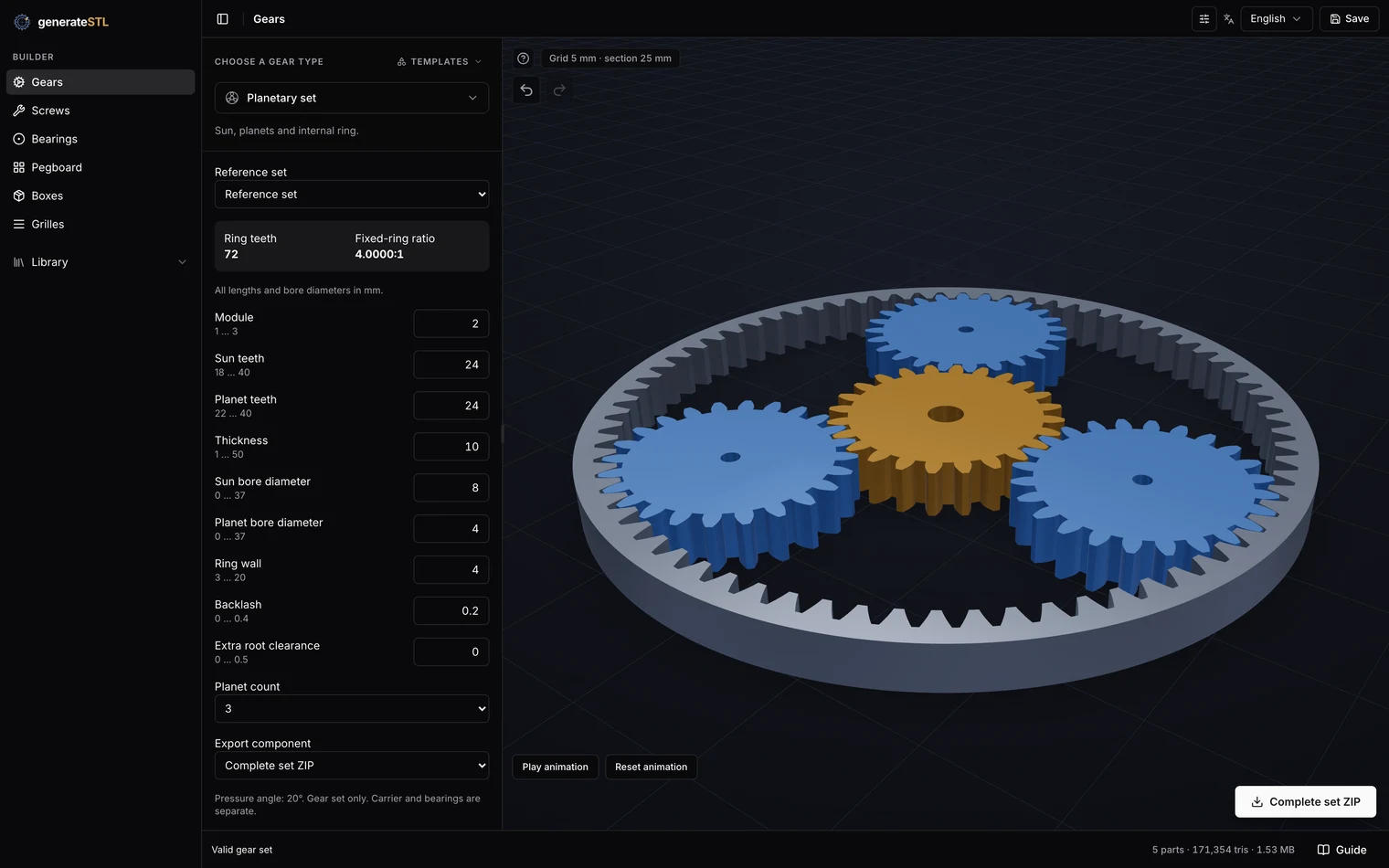
What moves in a planetary gear set
A planet gear does two things at once: it spins on its own axle, and that axle travels around the sun with the carrier. KHK describes the planetary gear as a gear that rotates around a centre which itself revolves around the sun gear.
The sun meshes with every planet through an external mesh. Each planet also meshes with the internal teeth of the ring. The carrier holds the planet axes at a fixed distance from the centre, so it sets the spacing and carries the pin loads, not the tooth form.
Name the fixed member, the input and the output before quoting any ratio. The same gear set behaves differently when those roles change, and tooth counts alone do not tell you the output speed. The rest of this guide uses four symbols: zS for the sun, zP for one planet, zR for the ring and N for the number of planets.
| Part | Meshes with | Role with the ring fixed |
|---|---|---|
| Sun | Every planet, external teeth | Input |
| Planet | Sun and ring, one axle each | Spins on its axle while the axle orbits |
| Ring | Every planet, internal teeth | Fixed to the housing |
| Carrier | Holds the planet axes | Output |
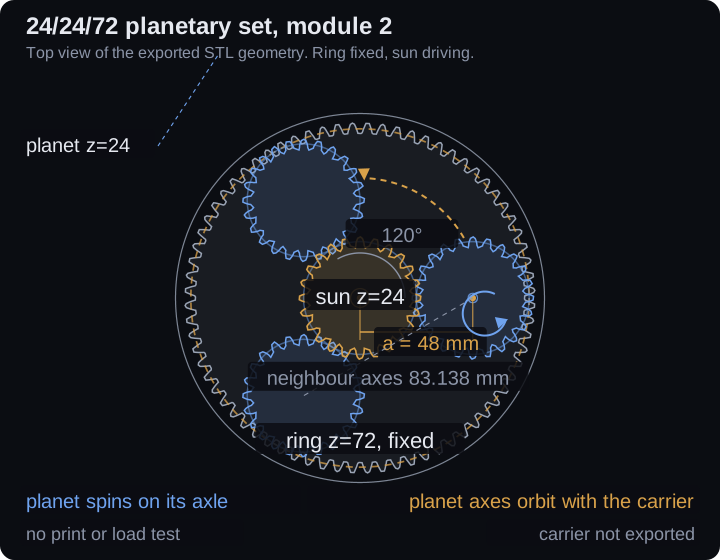
Work through a 24/24/72 set
The example is a complete recipe the builder accepts: module 2, sun 24 teeth, planet 24 teeth, ring 72 teeth, three planets, 10 mm thick, sun bore 8 mm, planet bore 4 mm, ring wall 4 mm, backlash 0.2 mm and extra root clearance 0 mm. This preset link opens the gear generator with exactly those values.
Module is the tooth size that all three parts share. Sun bore and planet bore are hole diameters, not radii, and a value of 0 produces a solid gear. Ring wall is the radial material thickness outside the internal tooth root, measured from the root rather than from the tooth tip.
Backlash is the play between the flanks of one mesh. Extra root clearance raises the dedendum above the standard 0.25 module clearance. The ring tooth count is not an input here: the builder derives it from the sun and planet counts, so 24 plus twice 24 fixes the ring at 72 teeth.
| Parameter | Value | What it controls |
|---|---|---|
| Module | 2 mm | Tooth size shared by all three parts |
| Sun teeth | 24 | Central external gear |
| Planet teeth | 24 | Each of the three identical planets |
| Planet count | 3 | Evenly spaced at 120 degrees |
| Thickness | 10 mm | Face width of every gear |
| Sun bore | 8 mm | Central hole diameter |
| Planet bore | 4 mm | Axle hole diameter |
| Ring wall | 4 mm | Radial material outside the tooth root |
| Backlash | 0.2 mm | Modelled play per mesh |
| Extra root clearance | 0 mm | Additional dedendum beyond 0.25 module |
Calculate the planetary gear ratio with the ring fixed
With the ring fixed, the sun driving and the carrier as output, the reduction is i = 1 + zR / zS. For 24 and 72 teeth that is 1 + 72 / 24 = 4, so 1000 rpm at the sun becomes 250 rpm at the carrier. KHK states the same relation for its planetary type, including that input and output rotate in the same direction.
The relation describes ideal kinematics. It assumes the ring is really grounded, the carrier is the only output, and nothing else holds the carrier back. Friction, backlash, elastic wind-up and the mounting structure change the delivered behaviour, so a 4:1 result is a speed relation and not a torque rating.
Other fixed members need their own expression. The same 24/72 set gives 1 + zS / zR = 4/3 with the sun fixed, and -zR / zS = -3 with the carrier fixed. The negative sign means that input and output turn in opposite directions. The fundamental planetary relation is often called the Willis equation.
For another tooth count or a different fixed member, the planetary gear ratio calculator keeps the operating case attached to its answer.
| Fixed member | Input to output | Relation | This set, 24 and 72 teeth |
|---|---|---|---|
| Ring | Sun to carrier | 1 + zR / zS | 4, same direction |
| Sun | Ring to carrier | 1 + zS / zR | 4/3, about 1.3333, same direction |
| Carrier | Sun to ring | -zR / zS | -3, opposite directions |
Check the planetary layout and tooth geometry
Three conditions must hold before three equally spaced planets can be assembled, and they are necessary rather than sufficient. This set passes all three: 72 = 24 + 2 x 24, (24 + 72) / 3 = 32, and 24 + 2 = 26 stays below 48 x sin 60 degrees = 41.569. The KHK internal gear catalogue states them as the gear tooth conditions for planetary gear mechanisms.
The conditions produce the dimensions. Pitch centre distance is m x (zS + zP) / 2 = 2 x (24 + 24) / 2 = 48 mm, measured as 48.0 mm in the export. Neighbouring planet axes sit 2 x 48 x sin 60 degrees = 83.138 mm apart. With a planet tip diameter of 52 mm, the tip circles keep 31.138 mm of space between them.
The same conditions show what changes with four planets: (24 + 72) / 4 = 24 is still a whole number, neighbouring axes move to 2 x 48 x sin 45 degrees = 67.882 mm, and the tip circles keep 15.882 mm between them. A four-planet request with the same tooth counts returned a valid archive in the export run behind this article.
Arithmetic alone does not prove interference-free contact. KHK asks designers to check involute, trochoid and trimming interference for internal gears. Two analytic criteria hold here: 72 teeth is above the 34-tooth validity limit for a standard 20 degree internal gear, and the 72 - 24 = 48 tooth difference is larger than the 9-tooth limit for trochoid interference.
KHK's gear dimension reference gives both criteria. Published interference tables remain product specific: the 2025 KHK catalogue lists at least 21 mating pinion teeth for its 60-tooth stock internal gear, and it has no 72-tooth row. Treat such values as a pattern to check, not as a number that transfers to another profile. Tooth counts are also bounded by the builder itself: planet gears need at least 22 teeth in this version, and a rejected preset leaves the gear type that was already selected in place instead of showing an unsupported set.
The builder runs its own checks on spacing, neighbouring planet clearance, external undercut, base tangent limits, contact ratio, ring wall, bore walls, flank thickness and the backlash and clearance limits. Those checks describe geometry. They do not describe a printed mechanism.
| Condition | Required | This set |
|---|---|---|
| Ring tooth count | zR = zS + 2 x zP | 72 = 24 + 2 x 24 |
| Equal spacing | (zS + zR) / N is a whole number | (24 + 72) / 3 = 32 |
| Planet clearance | zP + 2 < (zS + zP) x sin(180 / N) | 26 < 41.569 |
| Pitch centre distance | m x (zS + zP) / 2 | 48 mm |
| Neighbouring axes | 2 x a x sin(180 / N) | 83.138 mm |
| Internal gear fit | zR > 34 and zR - zP > 9 | 72 > 34 and 48 > 9 |
Generate, export and reopen the set
The export behind this article was executed against the current API: one request, one file named planetary-set-m2-s24-p24-n3-generatestl.com.zip, five STL files, a recipe and a readme. The download contains nothing else.
Reopening that archive returned all thirteen recipe fields unchanged: gear type, module, pressure angle, sun teeth, planet teeth, planet count, thickness, sun bore, planet bore, ring wall, backlash, radial clearance and display selection.
The five gears carry individual print coordinates with their base at z = 0, so each part can be sliced as it arrives. The recipe file adds the assembly data: role, index, position and rotation in radians for every part.
Every component also carries the recipe in its 80 byte STL header. Uploading one planet file therefore restores the complete set, which matters when a single part is reprinted or shared on its own. Each export additionally carries the GenerateSTL topology signature, so a component holds 18 facets more than the raw mesh.
| File in the ZIP | Bytes | SHA256 prefix | Content |
|---|---|---|---|
| sun.stl | 1565784 | 78c41d5c2f93 | 24-tooth sun, tip diameter 52.0 mm, bore diameter 8.0 mm |
| planet-1.stl | 1565784 | 6ebdea930e65 | 24-tooth planet, tip diameter 52.0 mm, bore diameter 4.0 mm |
| planet-2.stl | 1565784 | f212e5ea7d16 | Same geometry as planet-1.stl, separate archive entry |
| planet-3.stl | 1565784 | 1cf71441207a | Same geometry as planet-1.stl, separate archive entry |
| ring.stl | 2304984 | 9805ac37e16a | 72-tooth internal ring, outer diameter 157.0 mm |
| recipe.json | 868 | af0493b812ef | Parameters, derived values and part transforms |
| README.txt | 373 | d4a5887ab11f | Units, assembly note and stated limits |
GenerateSTL planetary gear set. Units: millimeters.
Each STL uses individual print coordinates with its base at z=0.
Print the sun, ring and 3 planet copies. Assemble axially.
Modeled tangential backlash per mesh: 0.2 mm.
recipe.json supplies assembly positions and rotations in radians.
Carrier, bearings and shafts are not included. No physical print or load validation.
What the exported files measure
The numbers below come from the exported vertex data, not from the input form. Teeth were counted from the top face profile of each mesh, holes from the smallest radius, and the volumes cross-check the two bore diameters: the planet carries 377 mm3 more material than the sun, which matches a bore difference of pi x (4 squared - 2 squared) x 10 mm.
Every part starts at z = 0 and ends at 10 mm, so the exported orientation already matches a print bed. No edge in any of the five meshes is used by more than two facets, and every signed volume is positive. Digital validity of this kind is a statement about the files, not about a printed part.
| Measurement from the export | Sun | Planet | Ring |
|---|---|---|---|
| Teeth counted from geometry | 24 | 24 | 72 |
| Tip or outer diameter | 52.0 mm | 52.0 mm | 157.0 mm |
| Bore radius | 4.0 mm | 2.0 mm | no bore |
| Smallest radius in the mesh | 4.0 mm | 2.0 mm | 70.0 mm, internal tooth tip |
| Height, z from 0 to 10 | 10.0 mm | 10.0 mm | 10.0 mm |
| Non-manifold edges | 0 | 0 | 0 |
| Triangles including the signature | 31314 | 31314 | 46098 |
| Signed volume | 17144.4 mm3 | 17521.4 mm3 | 29975.2 mm3 |
What the STL set does not include
The download contains gears only. A working mechanism also needs a carrier with planet pins, shaft support, a ring mount that takes the reaction torque and a housing. None of that is generated or tested in this workflow, and the readme states the same limit inside every archive.
No part of this process is a print or load test. Prusa's modelling guidance treats orientation and clearance as printer and material dependent, with no single universal value. Its 0.2 mm machine accuracy and its initial value of about 0.3 mm for movable parts are starting points for a calibration print, not a backlash specification for this gear set.
Backlash and root clearance are easy to misread. Backlash is the play between the flanks of a meshed pair, and the 0.2 mm above is modelled as tangential clearance per mesh. Each planet has two meshes, one with the sun and one with the ring, and the train accumulates play across them.
A standard full depth profile uses a 1.00 module addendum and a 1.25 module dedendum, which leaves 0.25 module of clearance. KHK describes that clearance as the gap that lets the two gears mesh without interference. Extra root clearance increases the dedendum; it does not create a root fillet.
When an assembly jams, separate the causes: a wrong tooth phase, flank interference, axis positions outside tolerance or a printing defect. When the output speed looks wrong, check which member is really fixed and whether the output is read from the carrier instead of a planet spinning on its axle. The 3D printed gears guide adds a repeatable fit test for printed pairs, and the gear module guide explains the tooth size that all three parts share.
Frequently asked questions
What does the carrier do?
The carrier holds the planet axes at the centre distance and keeps the three planets evenly spaced. With the ring fixed it is the output member, so it also carries the pin loads and the reaction of the output torque. It is not part of the exported ZIP and has to be designed separately.
Why does a 24/72 set give 4:1 with the ring fixed?
Because the reduction follows i = 1 + zR / zS while the ring is fixed and the sun drives. With 72 ring teeth and 24 sun teeth that is 1 + 3 = 4, so 1000 rpm at the sun becomes 250 rpm at the carrier in the same direction. The relation only holds while the ring is really grounded.
Are tooth-count equations enough to approve a design?
No. The three tooth-count conditions only show that three planets can be spaced equally. KHK asks for involute, trochoid and trimming interference checks on top of them, and print fit, axis positions and the carrier stay separate. This guide measured a valid export, not a working mechanism.
Does the export include the carrier and a complete gearbox?
No. The ZIP contains the sun, three planets and the ring as STL files plus recipe.json and README.txt. Carrier, shafts, bearings and housing are named as not included in the readme, and no print or load validation is claimed for the set.