Planetary Gear Generator
Build a matching sun, planet and ring set in the browser: set module, tooth counts, thickness, bores and backlash, check the actual gear geometry in the live preview, then export the parts as STL. The download contains the gears and their recipe only. Carrier, shafts and housing are not part of the model.
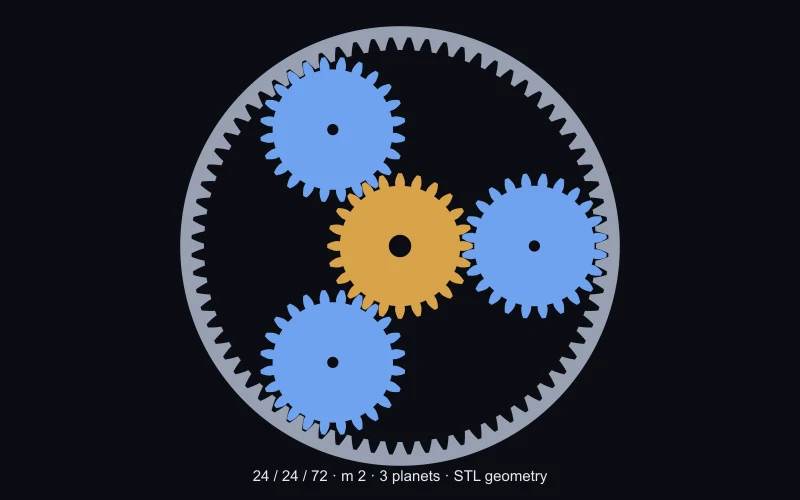
Build a complete gear set
The generator builds one planetary stage from straight, unshifted involute teeth at a fixed 20° pressure angle: a sun gear, three or four identical planets at one common centre distance, and an internal ring gear. It derives the ring tooth count as z ring = z sun + 2 × z planet and rejects tooth counts that fail the spacing, undercut, base tangent, interference or contact ratio checks.
The model is the gear set only. Carrier, planet pins, shafts, bearings and housing stay outside the export and are designed for your own printer and load case. In the builder the animation keeps the ring fixed, so the sun, the planets and the orbit of the planet axes stay readable. Every check on this page is a digital geometry check: not a print test, not a fit test and not a load rating.
Start with the verified 24/24/72 recipe
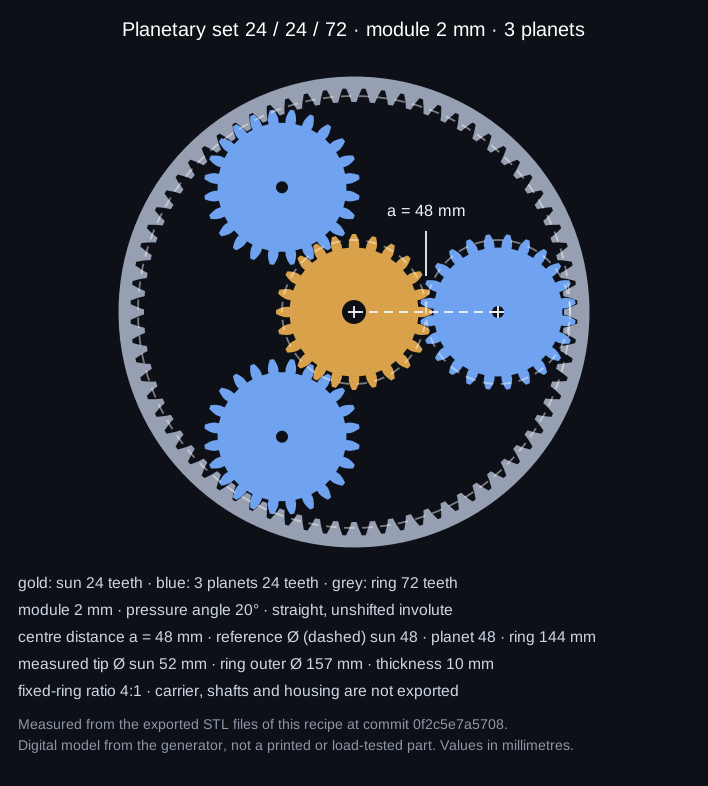
One recipe instead of a row of loose defaults: module 2 mm, 24 sun teeth, 24 planet teeth, 3 planets, thickness 10 mm, sun bore 8 mm, planet bore 4 mm, ring wall 4 mm, backlash 0.2 mm and extra root clearance 0 mm. Open the complete 24/24/72 recipe and the builder opens with every field filled in.
Reference diameter, tip diameter and centre distance follow the standard spur gear relations d = m × z, da = d + 2 m and a = (z1 + z2) × m / 2, see KHK gear dimension calculations. Verified on this page means the recipe ran through the current geometry code and the exported STL files were measured. It does not mean printed, fitted or load tested.
| Quantity | Value in this recipe | How it follows |
|---|---|---|
| Ring teeth | 72 | z ring = z sun + 2 × z planet = 24 + 2 × 24 |
| Reference diameter | Sun 48 mm, planet 48 mm, ring 144 mm | d = m × z at module 2 |
| Centre distance | 48 mm | a = m × (z sun + z planet) / 2 |
| Planet spacing | 3 planets at 120° | z sun + z ring = 96, divisible by the planet count 3 |
| Neighbour distance | 83.138 mm between axes, 31.138 mm between tip circles | 2 × a × sin(180° / n) minus the 52 mm tip diameter |
| Fixed-ring ratio | 4:1 | i = 1 + z ring / z sun |
Know which inputs are accepted
Accepted values: module 1 to 3 mm, 18 to 40 sun teeth, 22 to 40 planet teeth, three or four planets, thickness 1 to 50 mm, sun and planet bore from 0 mm, ring wall from 1.5 modules to 20 mm, backlash from 0 mm and extra root clearance from 0 mm. Numbers accept at most four decimal places. Pressure angle is fixed at 20° and profile shift is not offered for this set.
Coupled limits follow from the geometry: the ring wall needs at least 1.5 modules, backlash at most 0.2 modules, extra root clearance at most 0.25 modules, and each bore has to leave at least 1.5 modules of material below the tooth root. Sun teeth plus ring teeth must be divisible by the planet count. A value outside these limits is rejected with the reason shown in its field instead of being replaced silently.
Check the export before printing
The complete set exports as one ZIP with sun.stl, planet-1.stl up to planet-3.stl or planet-4.stl, ring.stl, recipe.json and README.txt. Selecting a single component exports that part alone as one STL. Every file is modelled in its own print orientation with its base at z = 0, and recipe.json carries the assembly positions and rotations in radians.
Each exported STL also stores the recipe in its header, so the ZIP and a single component STL both restore the complete parameter set and any single surviving file still carries the whole recipe. The export holds the gear geometry only: carrier, planet pins, shafts, bearings and housing are never part of it.
Before printing, open the parts in your slicer and compare tooth count, bore diameters and thickness against the recipe, then print one planet first if you want to test the fit on your own machine. The generator checks tooth counts, phasing, neighbour separation, profile limits, bore walls and clearance limits before export, but those checks are digital and say nothing about print accuracy, backlash after printing, strength or service life.
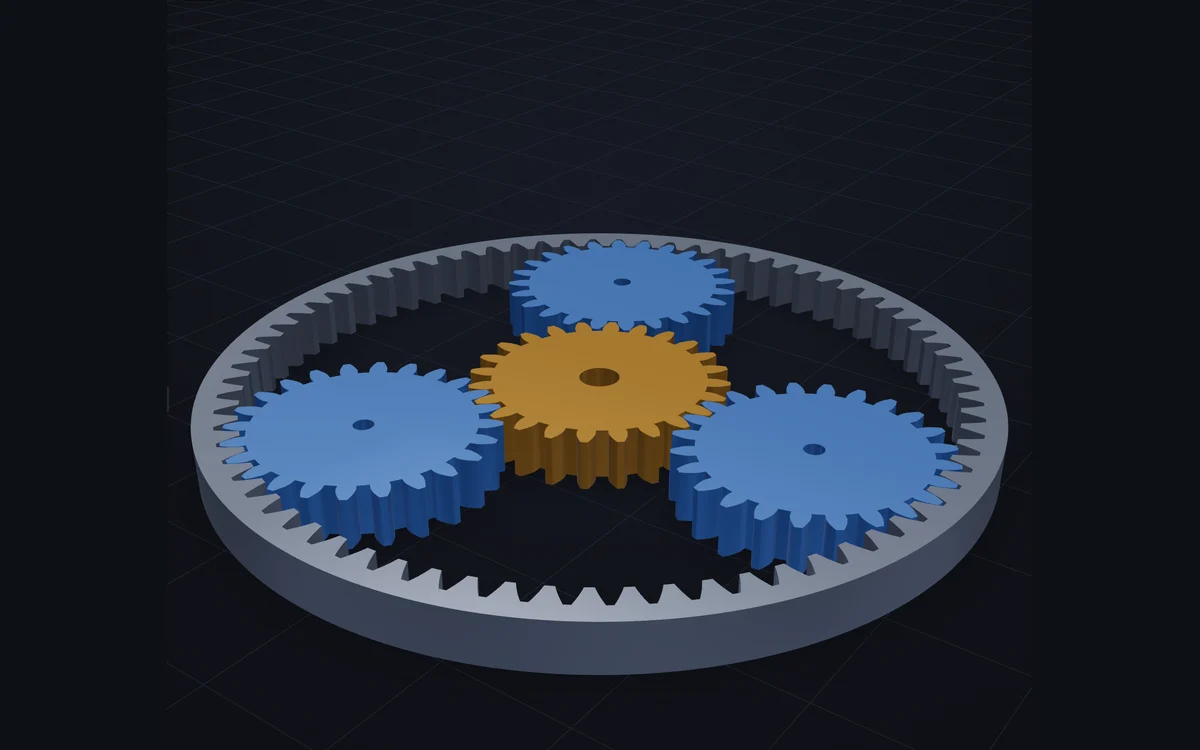
Understand the ratio
With the ring held fixed and the sun driven, the planet axes orbit at i = 1 + z ring / z sun. This example gives 1 + 72 / 24 = 4, so 100 rpm at the sun becomes a 25 rpm orbit in the same direction. Compare other fixed members in the planetary ratio calculator, and read the planetary gears guide for the full derivation. See planetary kinematics for the underlying relations. Other gear families and the remaining tools are listed in the generators overview.
Frequently asked questions
Which parts are exported?
The complete set exports as one ZIP with sun.stl, one STL per planet, ring.stl, recipe.json and README.txt. A single component exports as its own STL. Carrier, planet pins, shafts, bearings and housing are not part of any export.
Can I reproduce the complete example?
Yes. The 24/24/72 link fills module, tooth counts, planet count, thickness, both bores, ring wall, backlash and extra root clearance in the builder. The same values come back from recipe.json inside the ZIP and from the header of any single exported STL, so the recipe stays recoverable.
Does the generator include a carrier?
No. It models the sun, the planets and the ring. The positions in recipe.json only mark where a carrier would hold the planet axes. Carrier plates, pins, shafts, bearings and housing are designed for your own printer and load case.
How should I check the STL set?
Open every part in your slicer and compare tooth count, bore diameters and thickness against the recipe. Print one planet first to test the fit on your machine, then print the remaining planets, the sun and the ring. The generator's own checks are digital geometry checks, so the slicer review and a test print stay your own step.