Understand the geometry. Check the numbers.
Planetary gear ratio calculator
Calculate the speed ratio of a simple sun, planet and ring gear set. Choose one of three defined arrangements, then enter tooth counts, planet count and positive input speed. Separate checks show whether equally spaced standard planets pass the basic assembly conditions.
Your inputs
Results update immediately. Decimal point or comma accepted.
Whole number, 6 to 1,000.
Whole number, 6 to 1,000.
Whole number, 2 to 12.
Positive magnitude, 0.01 to 1,000,000.
Calculated result
- Input / output speed ratio
- 4 : 1
- Output speed
- 250 rpm
- Teeth per planet
- 24
Input and output turn in the same direction.
Basic spacing checks pass
- ✓ Tooth phasing: (24 + 72) / 3 = 32. Integer.
- ✓ Neighboring tip-circle separation: passes.
The ratio remains a kinematic calculation even if spacing fails. Passing these checks does not verify tooth interference or a printable assembly. The default sun / planet / ring set is 24 / 24 / 72.
Transfer defaults: module 2 mm, thickness 10 mm, sun/planet bore diameters 8/4 mm, ring wall 4 mm, backlash 0.2 mm, extra root clearance 0 mm. A carrier is separate.
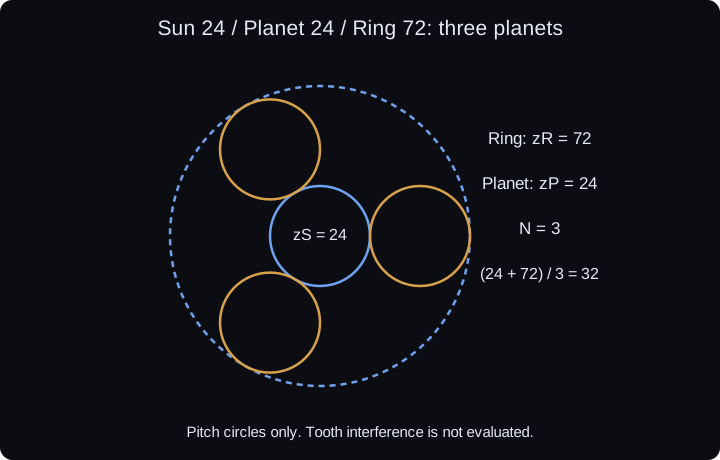
Read the fixed, input and output members
With the ring fixed, the sun drives the carrier and i = 1 + zᵣ / zₛ. With the sun fixed, the ring drives the carrier and i = 1 + zₛ / zᵣ. With the carrier fixed, the sun drives the ring and i = -zᵣ / zₛ. Here i = input speed / output speed.
A positive result means that input and output turn in the same direction. A negative result means opposite directions. These are three explicitly defined cases of the planetary speed relation zₛ × nₛ + zᵣ × nᵣ = (zₛ + zᵣ) × n꜀. They do not cover compound or stepped-planet gearboxes. Drivetrain Hub.
Technical reference: KHK Internal Gears, page 207: planetary mechanisms.
Worked example: sun 24, ring 72, three planets
Fix the 72-tooth ring, drive the 24-tooth sun at 1,000 rpm and take output from the carrier. i = 1 + 72 / 24 = 4 gives 250 rpm in the same direction. Each planet needs (72 - 24) / 2 = 24 teeth.
Three equally spaced planets satisfy (24 + 72) / 3 = 32. Planet count does not change the speed ratio. Other counts can fail the phasing condition.
Three basic assembly conditions
For an unshifted set with one common module, ring teeth must equal sun teeth plus twice the planet teeth. Fractional or nonpositive planet tooth counts cannot make the stated geometry. For N identical, equally spaced planets, (zₛ + zᵣ) / N must be an integer.
Adjacent standard planet tip circles also need separation: zₚ + 2 < (zₛ + zₚ) × sin(π / N). The calculator checks this strict inequality. A passing check still leaves tooth interference, undercut, clearances, carrier pins, bearings and ring-wall thickness to the detailed design.
Counter-example: sun 20, planet 20, ring 60
This is a separate case, not the worked example above. Sun 20, planet 20 and ring 60 satisfy the tooth-count relation 60 = 20 + 2 × 20, and the ratio still computes: with the ring fixed, 1,000 rpm at the sun gives 250 rpm at the carrier. The assembly checks do not all pass. Three equally spaced planets fail the phasing condition because (20 + 60) / 3 is not an integer. Four planets phase, and their neighboring tip circles stay separated.
Passing the spacing checks does not approve the design. For its own standard internal gears, KHK lists a lower limit of 21 pinion teeth against involute interference for a 60-tooth ring, so a 20-tooth planet falls below that reference. KHK Internal Gears, page 206 describes those standard gears; it is not a general limit for every generated profile, and tooth interference stays a separate check for each design.
The generator is stricter than the arithmetic. It accepts 18 to 40 sun teeth, 22 to 40 planet teeth and three or four planets, and it validates profile, engagement, bore walls and ring wall before export. At 20 planet teeth this set stays below the generator minimum of 22, so it remains a calculation result with no transfer link.
From the ratio to a gear set
Valid ring-fixed sets can open directly in the generator. In addition to analytical spacing checks, they must pass all generator profile, engagement, bore-wall and input checks. Sun-fixed and carrier-fixed cases remain available for calculation without a generator handoff. Carriers are not exported.
Module determines physical size, but cancels out of the ideal speed ratio and the dimensionless spacing checks used here. Select it later with the gear-module calculator. The displayed rpm is kinematic only; no torque rating, efficiency, load sharing, temperature rise or printed-part lifetime is calculated.
Transfer defaults are module 2 mm, thickness 10 mm, bore diameters of 8 mm for the sun and 4 mm for planets, ring wall 4 mm, backlash 0.2 mm and extra root clearance 0 mm. You can change them in the generator.
Common questions
Do more planets give a higher reduction?
No. For the ring-fixed arrangement, the ratio depends on the ring and sun tooth counts. Planet count affects assembly and the mechanical design, not this kinematic ratio.
Does a green assembly check prove the gearbox will run?
No. It confirms the two displayed spacing checks after the tooth-count relationship passes. Detailed tooth interference, strength, clearances and fabrication still require separate verification.